FAQ
1. What is Restacking the Odds?
Restacking the Odds (RSTO) is an evidence and learning partner to local early years partnerships, working to give every child an equitable start. RSTO is a joint initiative led by the Centre for Community Child Health at Murdoch Children's Research Institute, in collaboration with Social Ventures Australia and Bain & Company.
We work alongside local early years partnerships to help them measure what matters, see what's working and take action. Timely, actionable data supports this work, giving partnerships the evidence they need, when they need it, to build a stronger combination of high-quality services in their community.
RSTO aims to ensure that every child can access and participate in the high-quality early years services that help them thrive, from birth through to the early years of school, whatever their circumstance or wherever they live.
2. Why is Restacking the Odds needed?
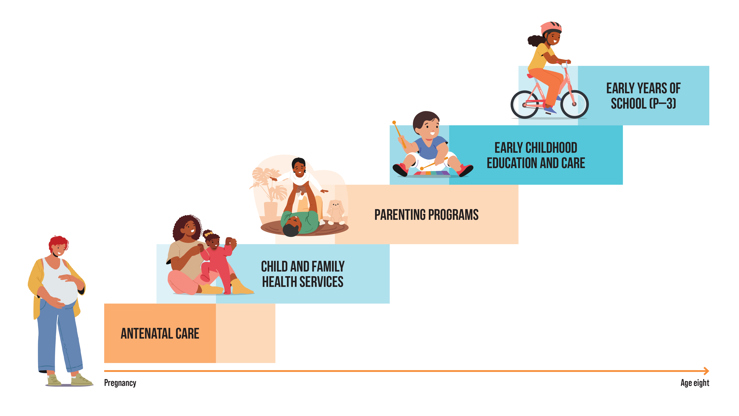
A child's early years are the foundation for lifelong health and wellbeing, and high-quality early childhood services play a key role in helping children reach their potential. No single service can do this alone – it takes the right combination of support from before birth through the early years of school.
When children and families engage with these services over time, and access additional supports as needed, the benefits add up. This is known as 'stacking'. But right now, that stack of support isn't reaching every child.
Local early years partnerships are working to change this, but they're often missing the right information at the right time to see who is missing out and what would help.
Part of the problem is how we measure: most measurement in the early years is built for reporting and telling governments and funders what outcomes have changed over time. While that’s a legitimate purpose, it’s backwards looking and hard for local teams to act on day to day.
What local early years partnerships need is data and measurement built for learning: evidence-informed and close to practice, timely and local enough to act on, and focused on the decisions partnerships need to make. That's the gap Restacking the Odds is designed to fill.
3. What do you offer and how can you support my early years partnership?
We offer a suite of tools and resources, including a lead indicator library, a test and learn platform, and tailored support, that help early years partnerships do three things:
- Measure what matters: start with the decisions a partnership needs to make, then find the data to inform them. Communities choose the indicators that fit their local priorities; nothing is prescribed or imposed.
- See what’s working: our tools make progress visible across quality, quantity and participation in close to real time, so partnerships can see what’s happening without waiting years for outcome data.
- Build capability to take action: we support partnerships to test changes, learn from what the data shows and adjust regularly, building the local capability to make improvement stick.
4. What is a lead indicator?
Lead indicators are a type of data that show whether you’re making progress towards your goals. Instead of waiting years to see results, lead indicators offer timely signals of change, so that local early years partnerships and services can see what’s happening and adjust as they go.
This is what lets us act on inequity – because to change who is missing out, we first must see where the gaps are and what’s making a difference. The right data at the right time supports better decisions that meet the needs of all children and families.
5. What is 'stacking'?
No single service can meet all the needs of children and families. ‘Stacking’ services is the practice of combining high-quality early years services over time and as needed, giving children what they need to get the best start in life.
6. What is your approach to Indigenous Sovereignty and Privacy?
Our approach to Indigenous Sovereignty and recognises Indigenous ownership, control and decision making. We acknowledge that data relating to Indigenous peoples and communities requires respectful, transparent and culturally safe handling.
Where data or information relating to Indigenous peoples, communities or culture is involved; it will only be stored, used or shared with the permission of Indigenous peoples and relevant Indigenous organisations.
Restacking the Odds is a national initiative led by the Centre for Community Child Health at the Murdoch Children's Research Institute, in collaboration with Bain & Company and Social Ventures Australia.



RSTO is supported by the Minderoo Foundation.